
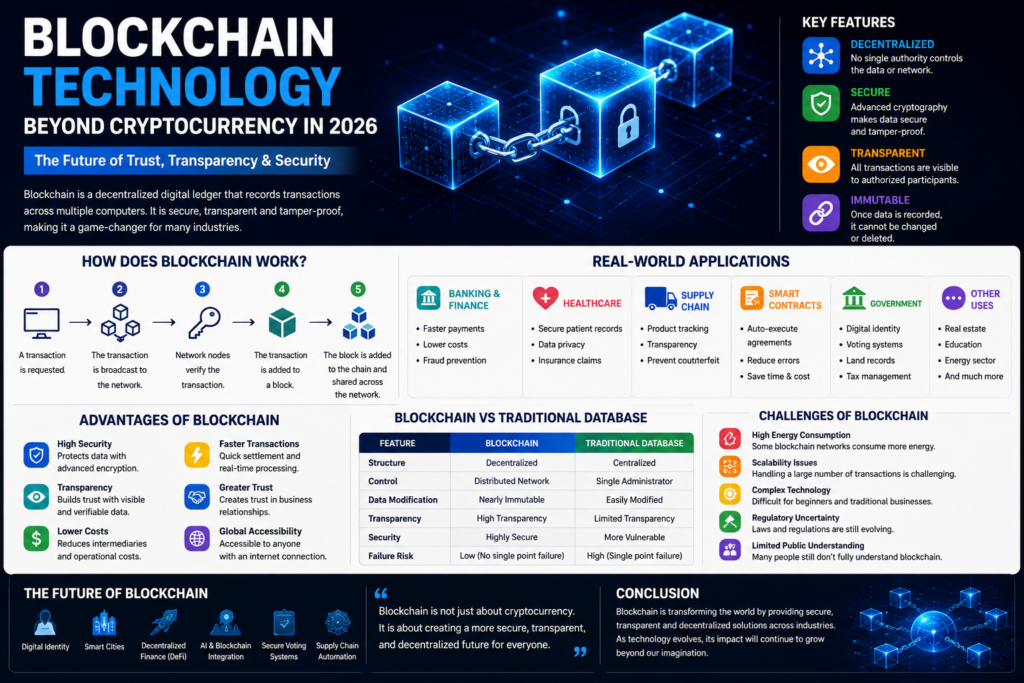
Blockchain Cryptocurrency in 2026
Blockchain Technology Explained: Beyond Cryptocurrency in 2026
Published on July 2026 • 11 min read
Introduction
When people hear the word Blockchain, they often think only about Bitcoin or cryptocurrencies. However, blockchain technology is much more than digital money. It is one of the most innovative technologies of the modern era, transforming industries such as finance, healthcare, supply chain management, cybersecurity, and even government services.
In 2026, businesses around the world are adopting blockchain to improve transparency, security, and efficiency. As digital transformation continues to accelerate, understanding blockchain has become an important skill for students, developers, entrepreneurs, and technology enthusiasts.
This article explains blockchain technology, how it works, its advantages, real-world applications, and why it will play a major role in the future.
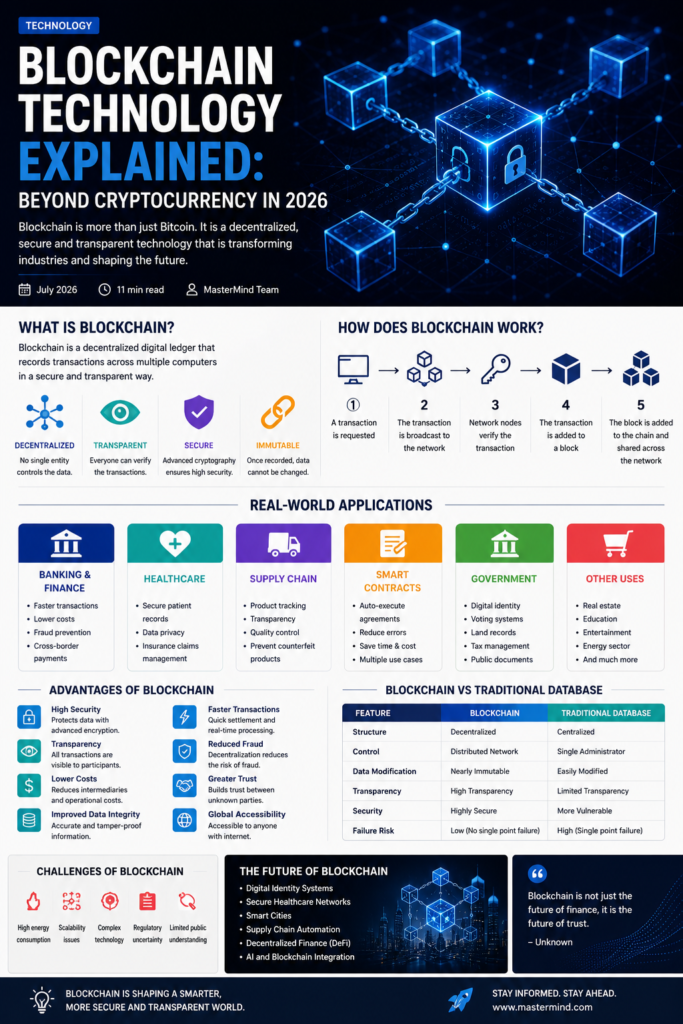
What Is Blockchain?
Blockchain is a decentralized digital ledger that securely stores information across multiple computers.
Instead of storing data in a single location, blockchain distributes information across a network of computers called nodes.
Each record is stored inside a block, and every new block is securely connected to the previous one, creating a continuous chain of information.
This structure makes blockchain highly secure and extremely difficult to alter.
How Does Blockchain Work?
Blockchain follows a simple but secure process.
- A user requests a transaction.
- The transaction is shared with the blockchain network.
- Network participants verify the transaction.
- Once approved, the transaction is added to a new block.
- The new block is permanently connected to the previous blocks.
- The updated blockchain is shared across the entire network.
Every transaction becomes a permanent part of the blockchain history.
Key Features of Blockchain
Blockchain offers several unique advantages.
Decentralization
No single organization controls the entire network.
Instead, information is shared among thousands of computers.
Transparency
Every transaction can be verified by authorized participants.
This improves trust between users.
Security
Advanced cryptography protects blockchain data from unauthorized changes.
Once information is added, modifying it becomes extremely difficult.
Immutability
Blockchain records cannot easily be changed or deleted.
This creates reliable and permanent transaction histories.
Real-World Applications of Blockchain
Blockchain technology is being used far beyond cryptocurrency.
Banking and Finance
Financial institutions use blockchain for:
- International Payments
- Digital Banking
- Fraud Prevention
- Asset Management
- Faster Transactions
Healthcare
Hospitals use blockchain to securely manage:
- Medical Records
- Patient Data
- Prescription Information
- Insurance Claims
This improves security while protecting patient privacy.
Supply Chain Management
Companies track products from manufacturing to delivery using blockchain.
Benefits include:
- Product Tracking
- Quality Control
- Counterfeit Prevention
- Improved Transparency
Smart Contracts
Smart contracts automatically execute agreements when specific conditions are met.
They eliminate unnecessary paperwork and reduce human error.
Examples include:
- Insurance Claims
- Property Sales
- Business Agreements
- Digital Payments
Government Services
Governments are exploring blockchain for:
- Digital Identity
- Voting Systems
- Land Records
- Tax Management
- Public Documents
Blockchain helps increase transparency and reduce fraud.
Advantages of Blockchain
Some of the biggest benefits include:
- High Security
- Better Transparency
- Faster Transactions
- Lower Costs
- Improved Data Integrity
- Reduced Fraud
- Greater Trust
- Global Accessibility
These advantages make blockchain valuable across many industries.
Challenges of Blockchain
Despite its benefits, blockchain also faces several challenges.
These include:
- High Energy Consumption (for some blockchain networks)
- Scalability Issues
- Complex Technology
- Regulatory Uncertainty
- Limited Public Understanding
Researchers continue working to improve blockchain performance and efficiency.
Blockchain vs Traditional Databases
| Traditional Database | Blockchain |
|---|---|
| Centralized | Decentralized |
| Easily Modified | Nearly Immutable |
| Single Administrator | Distributed Network |
| Lower Transparency | Higher Transparency |
| Greater Risk of Data Manipulation | Highly Secure Records |
The Future of Blockchain
Experts believe blockchain will continue expanding into new industries.
Future developments may include:
- Digital Identity Systems
- Secure Healthcare Networks
- Smart Cities
- Supply Chain Automation
- Decentralized Finance (DeFi)
- AI and Blockchain Integration
As technology advances, blockchain is expected to become a core part of the global digital economy.
Final Thoughts
Blockchain is far more than the technology behind cryptocurrencies. Its ability to create secure, transparent, and decentralized systems makes it one of the most promising innovations of the digital age.
Businesses, governments, and developers are continuously exploring new ways to use blockchain to improve efficiency and build trust.
Learning blockchain today can open exciting opportunities in technology, finance, cybersecurity, and software development.
Conclusion
Blockchain technology is transforming the way information is stored, verified, and shared. Its applications continue to grow beyond cryptocurrency, offering secure and transparent solutions for industries around the world.
Whether you’re a student, developer, entrepreneur, or technology enthusiast, understanding blockchain will help you stay prepared for the future of digital innovation.

Stay Updated 🚀
Get the latest tutorials, WordPress tips, AI updates and web development articles delivered directly to your inbox.
Related Posts

💬 Discussion
0 Comments