
AI Is Transforming Everyday Life in 2026
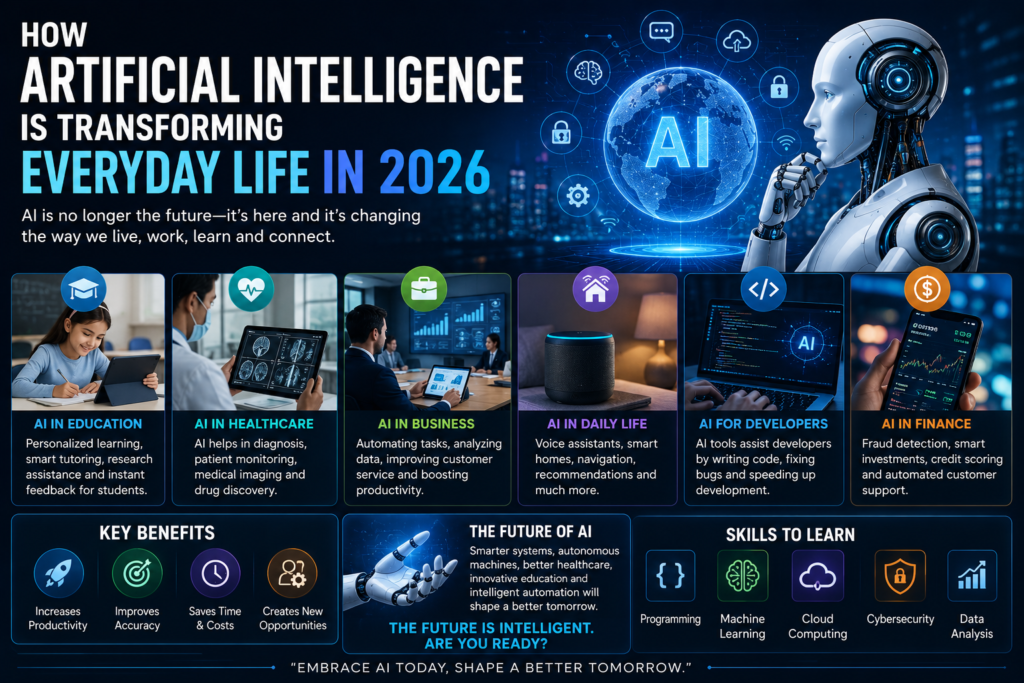
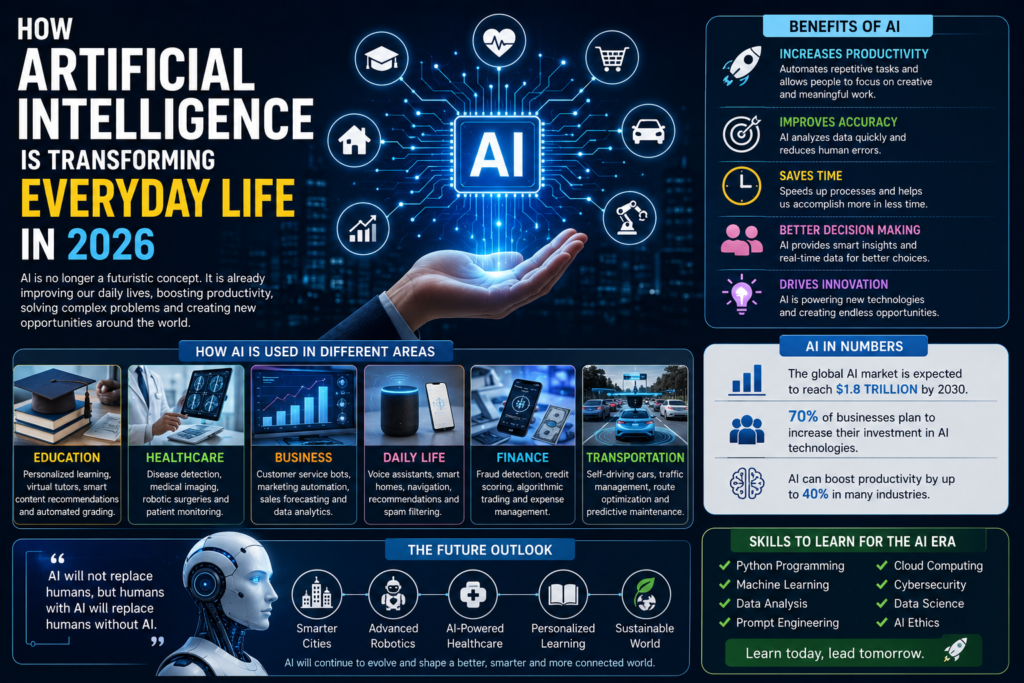
How Artificial Intelligence Is Transforming Everyday Life in 2026
Published on July 2026 • 10 min read
Introduction
Artificial Intelligence (AI) is no longer just a futuristic concept—it has become an essential part of our everyday lives. From smartphones and smart homes to healthcare and education, AI is changing how people work, communicate, shop, and solve problems.
In 2026, AI is helping businesses increase productivity, improve customer experiences, and automate repetitive tasks. Individuals are also using AI-powered tools to learn new skills, create content, manage daily routines, and even make smarter financial decisions.
This article explores how Artificial Intelligence is transforming everyday life and why understanding AI has become an important skill for the future.
1. AI in Education
Education has changed dramatically with the introduction of AI-powered learning platforms.
Students now receive personalized learning experiences based on their strengths and weaknesses. AI tutors can explain difficult concepts, generate quizzes, summarize textbooks, and provide instant feedback.
Benefits
- Personalized learning
- Faster research
- Homework assistance
- Language translation
- Smart note-taking
AI helps students study more efficiently while giving teachers better insights into student performance.
2. AI in Healthcare
Healthcare professionals are increasingly using AI to improve patient care.
AI systems can analyze medical images, assist doctors in diagnosing diseases, monitor patient health, and recommend treatment options more quickly than traditional methods.
Common Applications
- Disease detection
- Medical imaging
- Virtual health assistants
- Patient monitoring
- Drug discovery
AI is helping healthcare become faster, more accurate, and more accessible.
3. AI in Business
Businesses of all sizes are using AI to automate routine tasks and improve productivity.
Companies use AI for:
- Customer support chatbots
- Marketing automation
- Sales forecasting
- Data analysis
- Business intelligence
This allows employees to focus on creative and strategic work rather than repetitive tasks.
4. AI in Daily Life
Many people already use AI without realizing it.
Examples include:
- Voice assistants
- Smart home devices
- Email spam filters
- Navigation apps
- Online shopping recommendations
- Video streaming suggestions
AI quietly works behind the scenes to make everyday activities faster and more convenient.
5. AI in Software Development
Developers now use AI coding assistants to write cleaner code, detect bugs, and improve software quality.
AI helps programmers by:
- Suggesting code
- Explaining errors
- Writing documentation
- Automating repetitive coding tasks
- Speeding up development
This allows developers to build applications more efficiently.
6. AI in Finance
Banks and financial institutions use AI to improve security and customer service.
Applications include:
- Fraud detection
- Credit scoring
- Investment analysis
- Personal finance management
- Automated customer support
AI helps make financial services safer and more reliable.
7. AI and Smart Cities
Cities are becoming smarter through Artificial Intelligence.
AI is helping manage:
- Traffic systems
- Public transportation
- Energy consumption
- Waste management
- Public safety
These technologies improve efficiency while reducing costs and environmental impact.
8. Challenges of Artificial Intelligence
Although AI offers many benefits, it also presents challenges.
Some concerns include:
- Privacy issues
- Data security
- Job automation
- Ethical decision-making
- AI misuse
Governments and technology companies continue working to develop responsible AI systems.
9. Skills You Should Learn for the AI Era
As AI continues to grow, learning technology skills becomes increasingly valuable.
Recommended skills include:
- Programming
- Prompt Engineering
- Machine Learning Basics
- Data Analysis
- Cloud Computing
- Cybersecurity
- Digital Marketing
These skills will remain highly valuable in the coming years.
10. The Future of Artificial Intelligence
Experts believe AI will continue transforming industries over the next decade.
Future innovations may include:
- Smarter virtual assistants
- Autonomous transportation
- AI-powered healthcare
- Personalized education
- Intelligent business automation
The future of AI looks promising, and those who understand it today will have better opportunities tomorrow.
Final Thoughts
Artificial Intelligence is no longer a technology of the future—it is shaping our present. From education and healthcare to business and entertainment, AI continues to improve productivity, simplify daily tasks, and create new opportunities.
Instead of fearing AI, individuals should focus on learning how to use it effectively. Those who adapt and develop AI-related skills will be better prepared for the rapidly evolving digital world.
Conclusion
The rise of Artificial Intelligence marks one of the biggest technological revolutions in history. As AI becomes more integrated into everyday life, understanding its benefits, challenges, and opportunities will be essential for students, professionals, and businesses alike.
By embracing AI responsibly and continuously learning new skills, you can stay ahead in a technology-driven future and take advantage of the countless opportunities that AI will create.

Stay Updated 🚀
Get the latest tutorials, WordPress tips, AI updates and web development articles delivered directly to your inbox.
Related Posts

💬 Discussion
0 Comments