
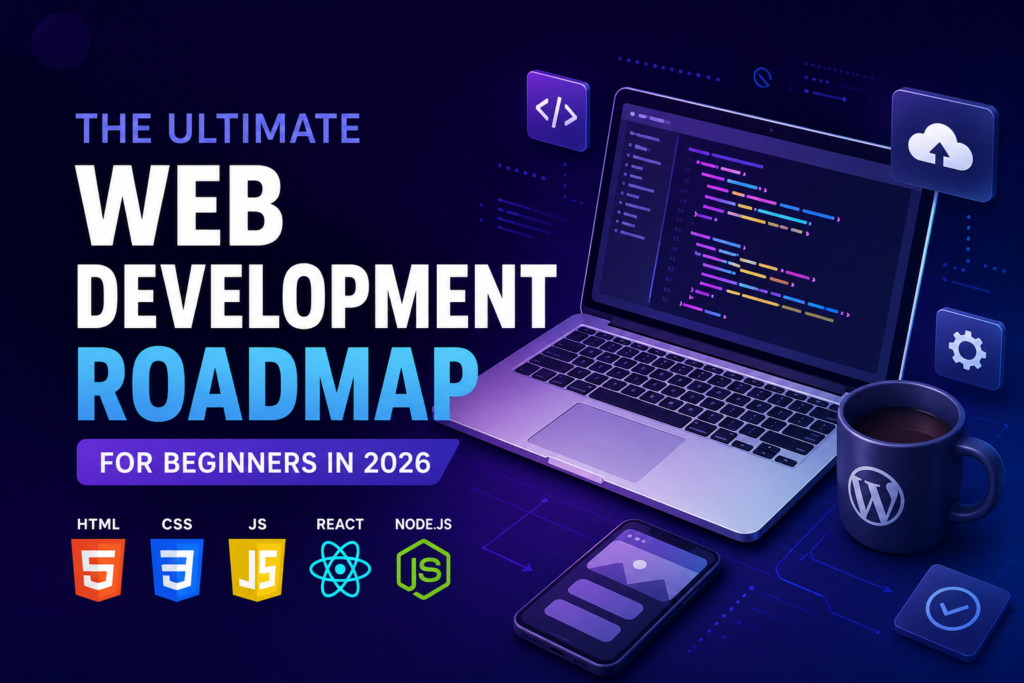
Web Development Roadmap for Beginners 2026
The Ultimate Web Development Roadmap for Beginners in 2026
Web development is one of the most in-demand skills in today’s digital world. Every business, startup, and personal brand needs a professional website, creating endless opportunities for developers. Whether you want to become a freelancer, secure a high-paying job, or build your own projects, learning web development is an excellent investment in your future.
The good news is that you don’t need a computer science degree to become a web developer. With the right roadmap, consistent practice, and dedication, anyone can learn web development from scratch.
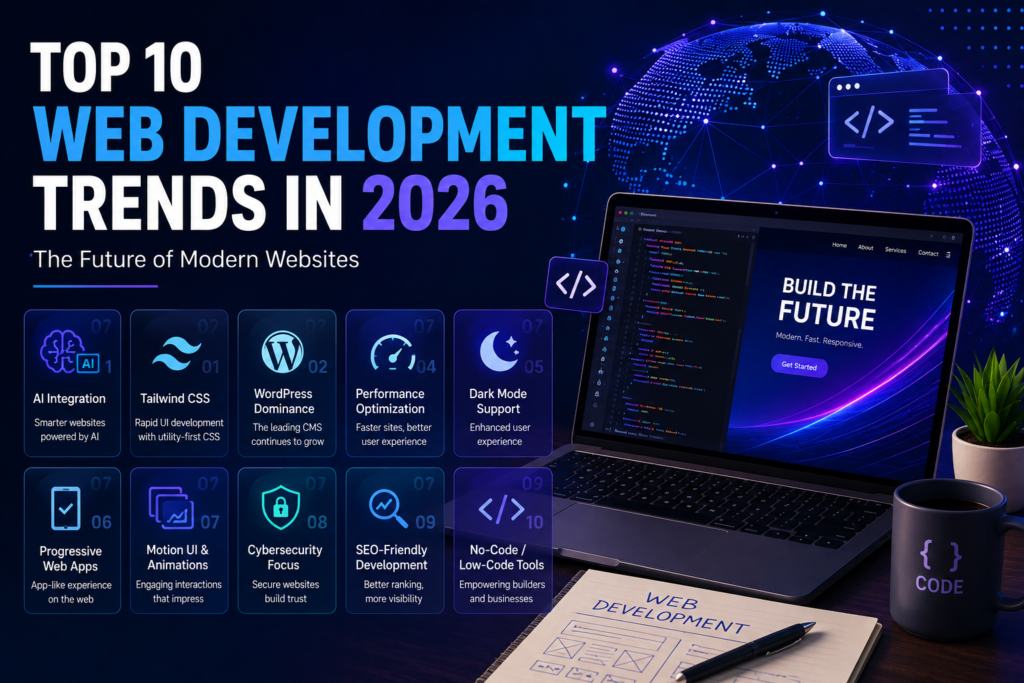
Step 1: Learn HTML
HTML (HyperText Markup Language) is the foundation of every website. It defines the structure of web pages using headings, paragraphs, images, buttons, forms, tables, and links.
Every aspiring web developer should first master HTML before moving to styling or programming.
Topics to Learn
- HTML Document Structure
- Headings and Paragraphs
- Images and Videos
- Tables
- Forms
- Semantic HTML
- Accessibility Basics
Step 2: Master CSS
CSS (Cascading Style Sheets) is responsible for making websites attractive. It controls colors, spacing, typography, layouts, animations, and responsive design.
Modern websites rely heavily on CSS to create professional user experiences.
Topics to Learn
- Selectors
- Box Model
- Flexbox
- CSS Grid
- Responsive Design
- Animations
- Media Queries
Step 3: Learn JavaScript
JavaScript adds interactivity to websites. Without JavaScript, websites would be static and unable to respond to user actions.
With JavaScript, you can build sliders, forms, calculators, interactive menus, and dynamic applications.
Topics to Learn
- Variables
- Functions
- Arrays
- Objects
- Loops
- DOM Manipulation
- Events
- Fetch API
- ES6 Features
Step 4: Learn Tailwind CSS
Tailwind CSS has become one of the most popular CSS frameworks because it allows developers to build beautiful user interfaces quickly using utility classes.
Instead of writing large CSS files, Tailwind helps you create responsive layouts directly in your HTML.
Step 5: Learn Git and GitHub
Version control is an essential skill for every developer.
Git helps track code changes, while GitHub allows you to store projects online, collaborate with other developers, and build a professional portfolio.
Step 6: Learn React
React is one of the most popular JavaScript libraries for building modern web applications.
It introduces concepts such as components, props, state management, and reusable UI elements that simplify large-scale development.
Step 7: Learn Backend Development
Frontend creates what users see, while backend handles data, authentication, databases, and server-side logic.
Popular backend technologies include:
- Node.js
- Express.js
- PHP
- Laravel
- Python Django
Step 8: Learn Databases
Every dynamic website stores information in a database.
Popular databases include:
- MySQL
- PostgreSQL
- MongoDB
Understanding CRUD operations, relationships, and queries is essential for full-stack development.
Step 9: Build Real Projects
The fastest way to improve is by creating real-world projects.
Some beginner-friendly ideas include:
- Portfolio Website
- Blog Website
- Weather App
- Calculator
- To-Do List
- News Website
- E-Commerce Store
- Business Landing Page
Projects demonstrate your practical skills and help build an impressive portfolio.
Step 10: Start Freelancing
Once you’ve built several projects, create profiles on freelancing platforms and begin applying for small jobs.
Focus on delivering quality work, collecting positive reviews, and continuously improving your skills.
Popular freelancing platforms include Upwork, Fiverr, and Freelancer.
Final Thoughts
Web development is a journey that rewards consistency and continuous learning. Technology evolves every year, but the core principles remain the same. By mastering HTML, CSS, JavaScript, modern frameworks, backend development, and building practical projects, you can create professional websites and open doors to exciting career opportunities.
Remember that becoming a successful web developer isn’t about learning everything at once—it’s about learning step by step, practicing regularly, and never stopping your curiosity. With dedication and persistence, 2026 can be the year you begin your career as a professional web developer.

Stay Updated 🚀
Get the latest tutorials, WordPress tips, AI updates and web development articles delivered directly to your inbox.

💬 Discussion
0 Comments