
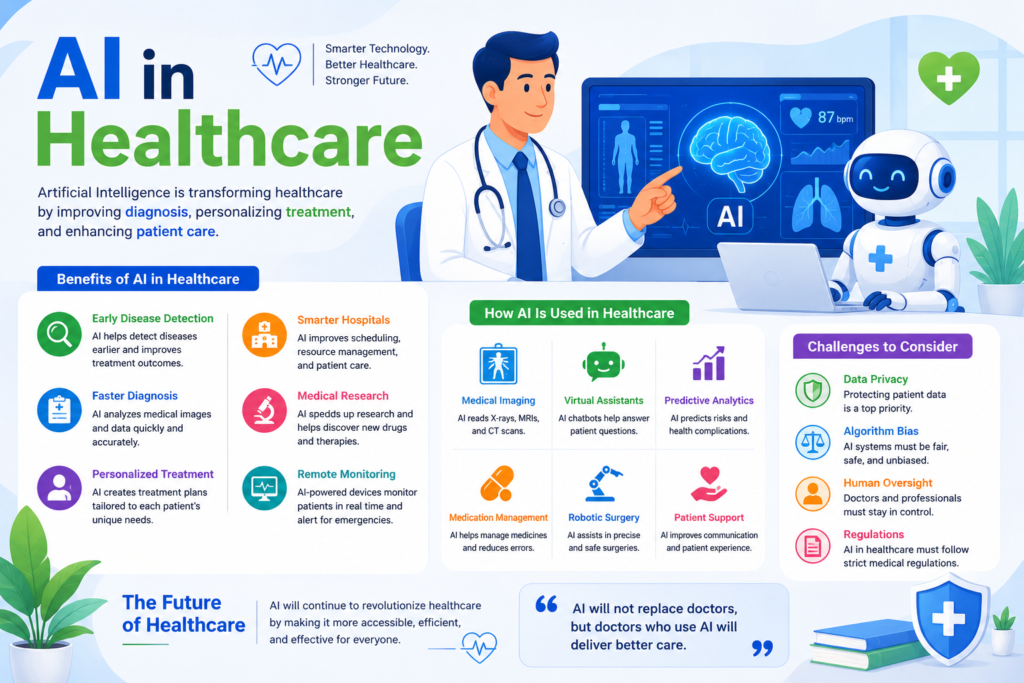
AI in Healthcare saving lives
AI in Healthcare: How Artificial Intelligence Is Saving Lives
Artificial Intelligence (AI) is transforming healthcare by helping doctors diagnose diseases faster, improving patient care, and supporting medical research. In 2026, AI has become one of the most valuable technologies in hospitals, clinics, and research centers around the world.
What Is AI in Healthcare?
AI in healthcare refers to the use of intelligent software and machine learning systems to assist medical professionals in making better decisions. These systems analyze large amounts of medical data, identify patterns, and provide valuable insights that help improve patient outcomes.
Early Disease Detection
One of AI’s biggest advantages is its ability to detect diseases at an early stage.
AI is helping doctors identify conditions such as:
- Cancer
- Heart disease
- Diabetes
- Alzheimer’s disease
- Lung infections
Early detection allows patients to receive treatment sooner, increasing the chances of recovery.
Faster Medical Diagnosis
AI-powered systems can analyze medical images like X-rays, CT scans, and MRIs in seconds. These tools assist radiologists by highlighting areas that may require closer examination.
Rather than replacing doctors, AI acts as an intelligent assistant that improves speed and accuracy.
Personalized Treatment Plans
Every patient is different. AI can analyze a person’s medical history, lifestyle, and test results to help doctors create treatment plans that are tailored to individual needs.
This personalized approach often leads to better healthcare outcomes.
AI in Hospitals
Hospitals are using AI to:
- Schedule appointments
- Monitor patients remotely
- Predict medical emergencies
- Manage hospital resources
- Reduce paperwork
- Improve patient communication
These improvements help healthcare providers deliver faster and more efficient services.
Medical Research
AI is accelerating medical research by analyzing millions of scientific papers and clinical records. Researchers use AI to discover new medicines, improve clinical trials, and better understand complex diseases.
This has significantly reduced the time required for many research projects.
Challenges of AI in Healthcare
Although AI offers many benefits, there are important challenges to consider:
- Protecting patient privacy
- Ensuring data security
- Reducing algorithm bias
- Maintaining human oversight
- Following medical regulations
Healthcare decisions should always involve qualified medical professionals.
The Future of AI in Medicine
Experts believe AI will continue to improve robotic surgery, remote healthcare, wearable health devices, and predictive medicine. As technology advances, AI will become an even more valuable partner for doctors and healthcare workers.
Final Thoughts
Artificial Intelligence is revolutionizing healthcare by making medical services faster, smarter, and more accurate. While AI cannot replace doctors, it can provide powerful support that helps save lives and improve patient care.
The future of medicine will be built on collaboration between human expertise and intelligent technology.
Keywords: AI in Healthcare, Artificial Intelligence, Medical AI, AI Technology, Future of Healthcare, AI Diagnosis, Machine Learning in Medicine, Healthcare Innovation, AI 2026.

Stay Updated 🚀
Get the latest tutorials, WordPress tips, AI updates and web development articles delivered directly to your inbox.
Related Posts
💬 Discussion
0 Comments